
19 chapters
The Concord Pacific story
From the public record, in time order. Each number in brackets links to its source.
Concord Pacific in its own words, and in the public record
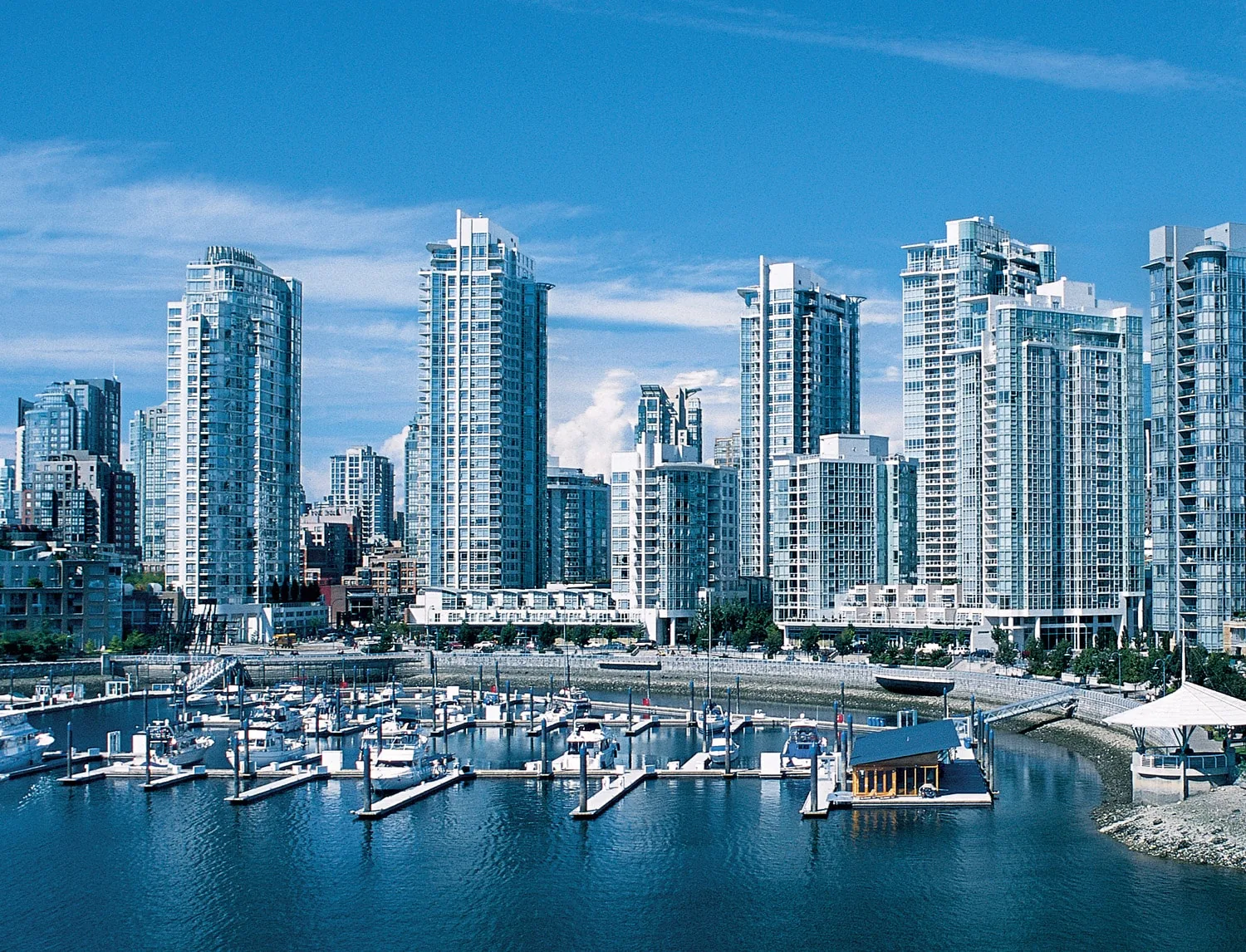
Concord Pacific describes itself as a builder of large planned communities in Canada, the United States and the United Kingdom. On its own site the company says it has completed more than 169 residential and mixed-use buildings, with more than 50 in planning or development, and that Concord Pacific Place in Vancouver includes more than 10,000 homes. Those are the company's own figures, and we have not checked them.[7],[40]
In a July 2019 judgment, the Supreme Court of British Columbia called the Concord Pacific Group "one of the largest residential developers in Canada" and wrote that at the time of that trial it had projects in British Columbia, Ontario, Calgary, Seattle and London, England, and that the court put its staff at 200 people, a number the judgment gives as approximate. The same judgment says Terry Hui and his family formed the Concord Pacific Group in 1987.[8]
Terry Hui leads the company, and its site names him president and chief executive officer of the Concord Group of Companies. The Tyee reported in March 2025 that Hui became chief executive in 1992, at 29, after Victor Li left for Hong Kong, that his family's firm merged with Concord in 1996, and that the Li family sold its remaining Concord shares to the Hui family in 1999.[7],[2]
Concord works through many companies. A search of OrgBook BC, the provincial registry of businesses, on October 24, 2026 returned at least 44 companies and partnerships with Concord Pacific in their names, 23 or more of them active. The City's 2004 rezoning report names the applicant for the Coopers' Park Neighbourhood as Pacific Place Developments Corp., and the design review that year names the owner as Concord Pacific Group Inc. OrgBook lists a Pacific Place Developments Corporation, registered on April 23, 1990, under its current name since July 22, 1997. No record we read says it is the same company, so this page gives no single legal name.[41],[12],[11]
The sale of the Expo lands, 1986 to 1988
Li Ka-shing told Bill Bennett, then head of the provincial government, at a private dinner in the summer of 1986 that he wanted to buy the Expo lands, according to The Tyee. By the summer of 1987 the provincial cabinet had agreed to sell the land as one parcel, and in September the Province asked for expressions of interest for 30 days. The Tyee reports that the whole sale took eight months, and that Li brought the architect Stanley Kwok, a long-time board member of the Crown corporation that owned the site, onto his bid team in the summer of 1987.[2]
Bill Vander Zalm, then head of the provincial government, announced the sale on April 27, 1988. A United Press International report from Vancouver the next day named the buyer as Concord Pacific Development Ltd., the Canadian subsidiary of Li's Hong Kong company Cheung Kong (Holdings) Ltd., and the seller as B.C. Enterprise Corp., a provincial agency, after a bidding process of 13 months. The price was $320 million in Canadian dollars, with $50 million paid first and the balance over 15 years. The report described plans for an office tower, a hotel, homes, shops, a marina with 630 berths and parks.[2],[3]
The terms included a later payment to the Province. The Tyee describes it as a participation agreement: for every square foot built above 13.2 million, Concord would pay $12.50 multiplied by an index of the rise in Vancouver real estate values since 1988. CBC News reported in 2016 that the real price is often put at $145 million, in part because the Province paid to clean the soil. The same report cites the geographer Kris Olds, who wrote in 2001 that Li's son Victor was put in charge of developing the site.[2],[16]
Planning the Expo lands, 1988 to 1990
The Tyee gives the Expo lands on the north shore of False Creek as 82 hectares. After the $50 million first payment, the terms set nine more payments from 1995 to 2002, and a separate agreement promised the Province a later payment for any building area above 13.2 million square feet, adjusted by a real estate index.[2]
Council adopted the False Creek North Official Development Plan on April 10, 1990. The City's 2004 report says the plan guides land use across the former Expo lands and sets the floor area, homes and heights for each sub-area. It set aside Area 6A, east of the Cambie Bridge, as a residential area around a waterfront park. The Tyee reports that the 1990 plan provided for 9,100 homes and that Concord promised to finish the project by 2005.[12],[2],[42]
Concord sold parts of the land within two years. The Supreme Court of British Columbia found that Oei Hong Leong, a businessman from Singapore, bought the Plaza of Nations lands from Concord in 1989 for $40 million to hold as a long-term investment; The Tyee dates that sale to January 1990. The Tyee also reports that Lee Shau Kee, a partner in Concord, won City approval to develop the eastern parcel on Pender Street, which became International Village with 800 homes.[8],[2]
Under the 1990 plan, Area 6A was to hold 511 homes in one long building with three towers, two of 17 storeys and one of 33, reached by a dead-end street. Council later approved new protected views across the site, and the City's 2001 plan for northeast False Creek proposed carrying Smithe Street across Pacific Boulevard into the area. The City's 2004 report gives both changes as reasons for the new plan of 2003.[12]
Yaletown Edge and Governor's Tower, 1990 to 2000
Yaletown Edge is the north side of the 1100 to 1300 blocks of Pacific Boulevard, three blocks between Pacific Boulevard and Yaletown. Concord Pacific Developments Ltd. applied to rezone them, and at the public hearing on June 14, 1990, Stanley Kwok, a director and senior vice-president of the company, told Council he had listened to the neighbours and that, with Council's support, the transfer of the north shore of False Creek to Pacific Place could begin. Council approved the rezoning with three aldermen opposed and enacted By-law No. 6757 on November 6, 1990.[10]
Kwok objected that evening to a late condition from the City Engineer that would have required the owner to build at least 100 public parking spaces and sell them to the City at cost, calling it onerous, unreasonable and unacceptable. He said the alternative, a joint parking project, was acceptable, and Council adopted the alternative. Other conditions required Concord Pacific to apply to rezone Area 2 within a year, to finish the park and community centre there, and to provide public art and sites for social housing.[10]
Governor's Tower, at 388 Drake Street, stands in Area 1, the triangle west of Drake Street, where the by-law set an 87-metre height limit. BC Assessment dates the 237 lots on its strata plan to 1995, and in 2011 UrbanToronto described Yaletown Edge as the first projects completed in Concord's Pacific Place. In January 2000, City staff reported 646 homes complete in Yaletown Edge with one site left, wrote that the developer had built fewer market homes than the zoning allowed, and proposed raising the Area 1 limit from 234 homes to 237 to match what was built.[10],[23],[24],[21],[22]
The same 2000 report set out the last Yaletown Edge site, 1125 Pacific Boulevard. Concord Pacific offered to build 60 non-market homes for families there at 90 percent of the maximum budget of the Province's Homes BC program, if the City built public parking on the site. Staff recommended 140 public parking spaces at a cost Concord agreed would not exceed $3,407,524, or $24,340 per space, to serve the Yaletown heritage area.[21]
From the Li family to the Hui family, 1992 to 1999
Construction was under way in 1992 when Li Ka-shing called Victor Li back to Hong Kong, The Tyee reports, and Terry Hui became chief executive at 29, with Stanley Kwok staying on as senior vice-president. The Tyee writes that Hui had degrees in electrical engineering and physics from Berkeley and had worked on his father's Vancouver developments. The Encyclopedia of British Columbia says he moved to Vancouver in 1985 to work on his father's development projects.[2],[15]
The Tyee reports that the Lis sold their controlling interest to the Hui family, until then a minority partner, and that in 1996 Hui merged his family's Burcon Group with Concord, with Burcon buying Concord Pacific for $250 million. At that time, by The Tyee's account, Concord had paid $70 million of the $320 million it owed the Province for the land.[2]
In 1999 the Lis sold their remaining stock in Concord to the Hui family. The Tyee reports that the Lis were paid $22.8 million for six lots set aside for non-market housing and kept a right of first refusal if those lots changed hands, a right that led to a later dispute. The Tyee also reports that before 1992, Victor Li and Hui had invested together in Vancouver real estate under the name Grand Adex.[2]
Building Concord Pacific Place, 1993 to 2016
UrbanToronto's 2011 survey of the early towers dates Parkview Tower in Yaletown Edge to 1993, Parkview Gardens to 1994, Peninsula in the Roundhouse area to 1996, Aquarius to 1999 and The Concord to 2003. It names the architects of the early areas, among them Hancock Bruckner Eng + Wright, Henriquez Partners Architects and James Cheng, whose first Concord buildings were the Aquarius towers across from the old railway roundhouse.[24]
The company's own project list gives a completion date for each tower. By its account, Concordia Tower at 199 Drake Street was finished in February 1996, Crestmark and The Waterworks in 1997, Landmark 33 and Columbus in 1998, Marinaside in November 2000 and Quay West in January 2002. The towers along Beach Avenue and Beach Crescent followed from 2003 to 2006, and the Coopers' Park towers from 2006 to 2008. The Erickson, at 1560 Homer Mews, is listed for January 2010.[9]
The company's timeline lists the public places it says came with the towers: David Lam Park in 1995, the Roundhouse Community Centre in 1997, Elsie Roy Elementary School and George Wainborn Park in 2004, and the seawall from David Lam Park to Homer Street by 2010. The Tyee reports that in the first 15 years under Hui, Concord built thousands of homes between the Granville Bridge and the Cambie Bridge, and that after 2005 the pace of building on False Creek slowed.[7],[2]
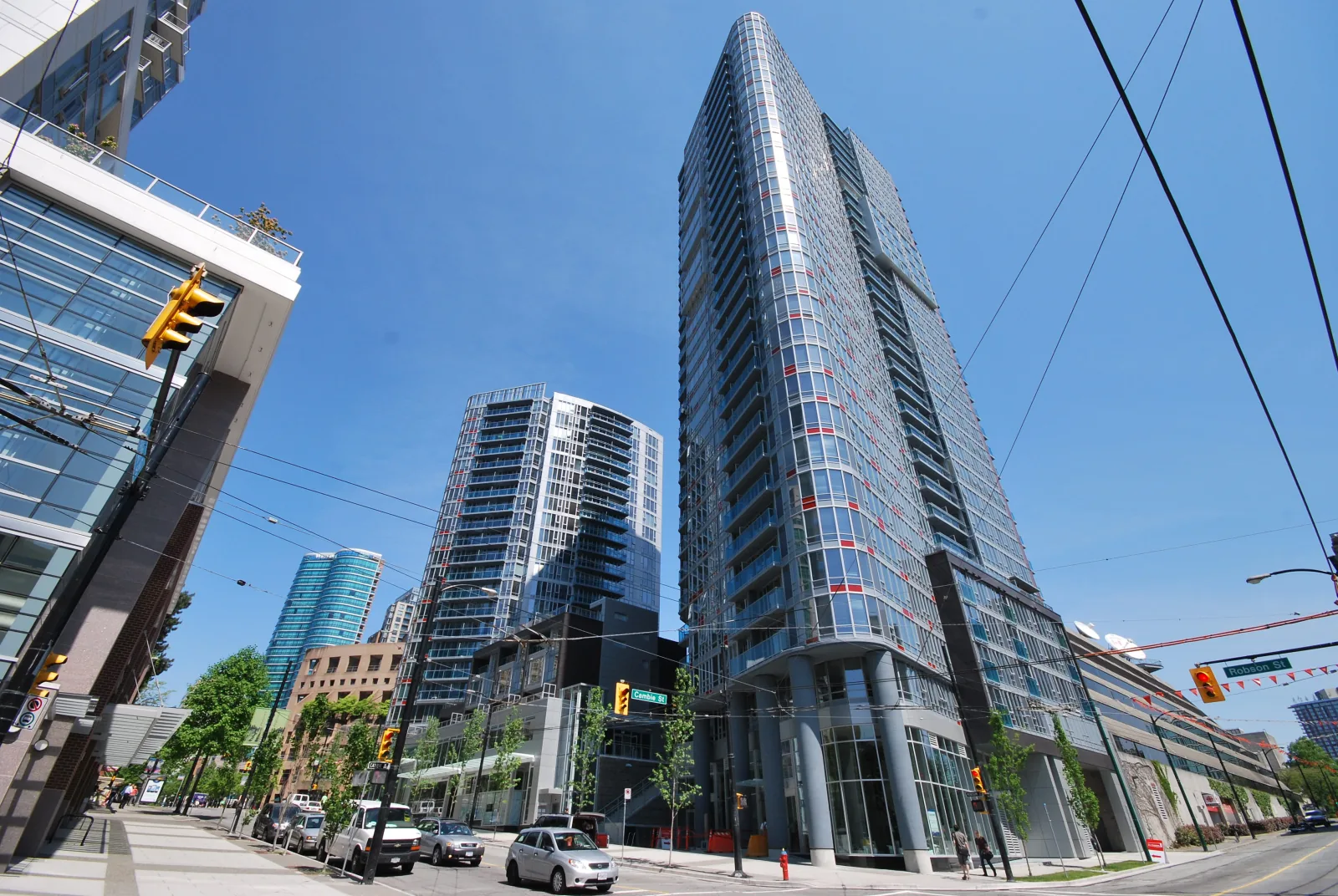
Concord also built outside the Expo lands in Vancouver. Its list includes TV Towers at 233 Robson Street in 2009, Smart at 168 Powell Street and The Grand on Oak at 6000 Oak Street in 2009, Cosmo at 161 West Georgia Street in 2012, and Uptown and Alexandra in 2013. One Pacific at 68 Smithe Street is listed for July 2016, The Arc at the north end of the Cambie Bridge was finished in 2019, SkyriseVancouver reported, and Avenue One is listed for 2020.[9],[26]
The Coopers' Park Neighbourhood rezoning, 2003 to 2004
The rezoning application for 900 Pacific Boulevard reached the City on June 24, 2003, from James KM Cheng Architects for Pacific Place Developments Corp. The revised plans of December 1, 2003 showed five market buildings with 613 homes and a site for a 15-storey building of 101 non-market homes. Floor area rose to 70,558 square metres, 20 percent above the 1990 figure, and homes rose to 714, 40 percent above the 511 first approved.[12]
Most of the added floor area came from another sub-area. The applicant proposed to move 10,994 square metres of commercial floor area from Area 5B, west of Pacific Boulevard, and convert it to homes. City staff put off setting the value of that transfer to a later review, and in the meantime asked for a covenant that blocked any development on Areas 5B, 6C and 6G until the City was satisfied about that value.[12]
At the public hearing on May 20, 2004, Council heard 3 speakers in support, 5 against and 21 more about the delay of the Creekside Park extension, a park the plan change moved to a later phase. A representative of Pacific Place told Council that the rezoning of Areas 5B and 6C would follow as soon as possible. Council approved the rezoning with Councillors Fred Bass and Tim Louis opposed, and enacted By-law No. 8896 on July 20, 2004.[4]
“This new neighbourhood will complement the recently developed Quayside neighbourhood to the west.”
What the City asked for in return
The 2004 conditions required the owner to add 1,226 square metres to Coopers' Park and rebuild parts of the park to fit, and to dedicate, transfer or lease to the City the land under the Cambie Bridge and its ramps, the extensions of Marinaside Crescent and Smithe Street, and the shoreline walkway. The owner also had to build Smithe Street from Pacific Boulevard with a traffic signal, connect the park to the spiral ramp on the Cambie Bridge, and finish the seawall works along the site within 10 years of the rezoning.[4],[12]
Other conditions covered housing, art and soil. The owner had to convey sites for 101 non-market homes to the City at a price acceptable to Council, sign an agreement for public art, submit soil studies with a clean-up plan approved by the Province, and accept a covenant that no one could move into a new building until the Province confirmed the clean-up. Council also asked the owner to provide, at no cost to the City, an early design for a future park on Area 9.[4]
Three permits in one afternoon, September 27, 2004
On August 18, 2004, the Urban Design Panel, the City's advisory group of design professionals, reviewed three applications in the neighbourhood, each with Concord Pacific Group Inc. as owner. It supported Building A by Walter Francl 6 to 0, Buildings B and D by Hotson Bakker Boniface Haden 6 to 0, and Building C by Hancock Bruckner Eng & Wright 4 to 2.[11]
On September 27, 2004, the Development Permit Board approved all three. Building A was a 15-storey tower with 86 homes, Buildings B and D two 24-storey towers with 223 homes, and Building C a 30-storey tower with lower parts of 6 and 10 storeys and 219 homes. The Board let each tower add one storey within the height limit and asked for proper front doors on the townhouses facing the park, as Council had asked for townhouses around the base of every market building.[20]
City staff told the Board that afternoon that Concord would use a checklist based on a formal green building rating, without applying for the rating, and that the City would monitor the results. Panel members asked for a rule that buyers be told in writing about noise from the Plaza of Nations and BC Place; the Board declined, and Co-Director of Planning Larry Beasley urged Concord to make sure buyers were informed.[20]
Mariner at 918 Cooperage Way, finished in 2008
Buildings B and D became the two towers of strata plan BCS3202, by our reading of the City's records: the company and listing sites call them Mariner, at 918 Cooperage Way, and Flagship, at 8 Smithe Mews. The 2026 tax roll lists 133 lots at 918 Cooperage Way and 112 at 8 Smithe Mews. BC Assessment gives 2008 as the year built for all 245, and they first appear on the 2009 roll.[25],[20],[11],[9]
The 2004 permit approved 223 homes in the two towers, 13 of them townhouses, over two levels of parking with 405 spaces. The records we read do not explain why the strata plan holds 22 more lots than the permit counted. The company's project list gives November 2008 for Mariner and December 2008 for Flagship. The building page for 918 Cooperage Way sets out its planning, values and ownership rules in full.[20],[25],[9]
CityPlace in Toronto, 1997 to 2025
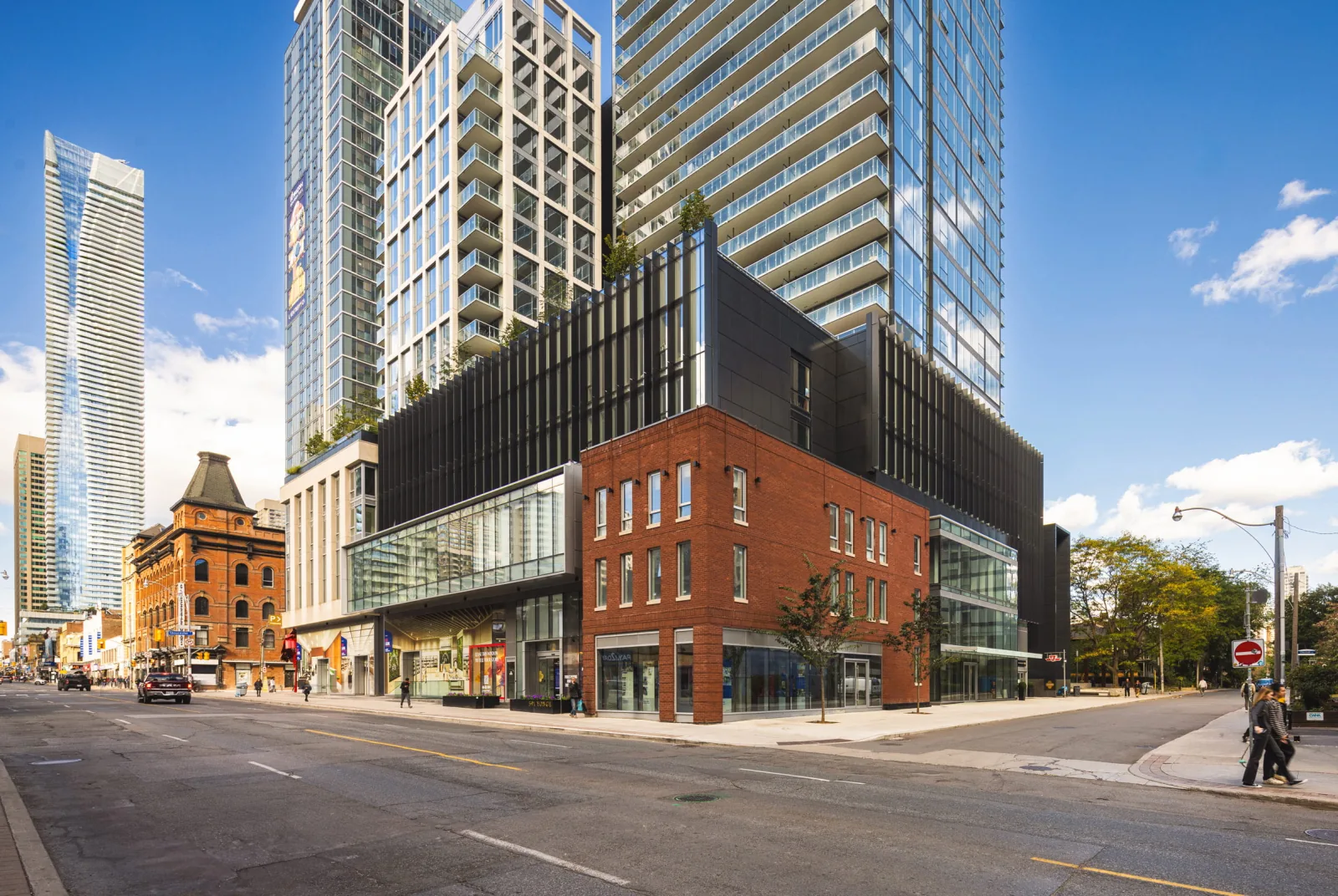
In 1997 Concord Adex, the company's Toronto arm, bought 35 acres of railway land it no longer needed from Canada Lands, the federal Crown corporation, according to the Daily Commercial News. The land lay west of Spadina Avenue, between Front Street, Bathurst Street, Lake Shore Boulevard and the stadium now called Rogers Centre. Real Estate News Exchange reported in 2021 that Concord Adex is a subsidiary of Concord Pacific and gave the site as 55 acres, a figure that counts a larger area.[30],[5]
At a 2021 webinar, Gabriel Leung, vice-president of development at Concord Adex, said CityPlace would hold 31 towers with 12,000 homes for 21,000 residents, two schools, a community centre, a library, two daycares and a park of eight acres, Canoe Landing Park. The news site reported that 29 towers were complete. Leung said Concord Adex had paid for the community infrastructure, a $14 million public art program, a bridge over the rail tracks, parks and roads, and had given the City land for affordable housing.[5]
The architect Mansoor Kazerouni told the Daily Commercial News in 2024 that his firm, then Page and Steele and now part of Arcadis, worked with James Cheng of Vancouver on the first plans and took part in the design of all 31 towers. The last two, Concord Canada House at 23 Spadina Avenue, rise 65 and 75 storeys with 1,397 homes, and occupancy was set for 2025. The Skyscraper Center lists the three Parade towers as finished in 2013, the tallest at 132 metres.[30],[31]
Reports differ on the size of the project. The Tyee wrote in 2025 that CityPlace is a 7,500-home project on 18 hectares, while the 2021 webinar figure was 12,000 homes. A 2017 Daily Hive report on the launch of Canada House gave planned heights of 68 and 79 storeys, taller than the 65 and 75 the 2024 report gives for the towers under construction.[2],[5],[18],[30]
Concord Park Place in North York, 2006 to 2022
Concord Park Place stands on land Canadian Tire once owned at Sheppard Avenue East and Leslie Street in North York, part of Toronto. A City of Toronto report of May 20, 2022 sets out its history. Canadian Tire applied to build a mixed-use community there in 2000, and Council approved the plans in November 2002. In late 2006 Concord Adex bought the lands, except the Canadian Tire store, a block west of it and the office block at the corner.[32]
Concord Adex revised the layout in 2009 and 2010 and, in November 2011, appealed to the Ontario Municipal Board because Council had not decided within the time the Planning Act allows. The City and the company settled the open points, which included building heights, homes sized for families and payments for community benefits, and the Board approved the plan on March 8, 2013.[32]
In March 2022 Concord Adex applied for Block 7, at 1001 Sheppard Avenue East, where the 2013 zoning allowed 270 homes at 8 storeys. It proposed two towers of 24 and 29 storeys on a 6-storey base with 686 homes, 67 of them with three bedrooms, designed by Dialog. The company's list also names Opus and Omega on the Park at Concord Park Place, both given 2018 dates.[32],[9]
Burnaby, Richmond and Surrey
In Burnaby, Council adopted the master plan for the Concord Brentwood site, south of Lougheed Highway between Beta and Delta Avenues, on June 13, 2016. A City report of April 20, 2022 describes Phase 3, the last phase, on land then holding older industrial buildings: four strata towers of 38 to 50 storeys and a 27-storey non-market rental building, 2,004 homes in all, 254 of them rentals set 20 percent below the median rent. The plan adds a city park of 5.33 hectares, to be handed to the City with clean soil before people move into Phase 3A.[28]
At Metrotown, Council adopted the master plan for the former Sears site at Kingsway and Nelson Avenue on December 16, 2019, with a first phase of three residential towers. An October 2022 City report on Phase 2 counted 1,464 homes in Phases 2A and 2B, with towers of 40, 49 and 58 storeys, and an office or hotel tower of 47 storeys and a rental tower of 60. The company lists The Met and The Met2, two earlier towers on Nelson Avenue, for 2015 and 2017.[29],[9]
In Richmond, the company lists Fullerton on Ferndale Road for December 2008 and Monet on Cook Road for September 2015, and Concord Gardens near Capstan Way and No. 3 Road from 2016, with Park Estates and Central Estates in 2017 and Galleria later. In Surrey's City Centre it lists Park Place on Whalley Boulevard for November 2011 and the two Park Avenue towers on 100 Avenue for 2016 and 2017. These Richmond and Surrey dates rest on the company's own list.[9]
Calgary, Seattle and London
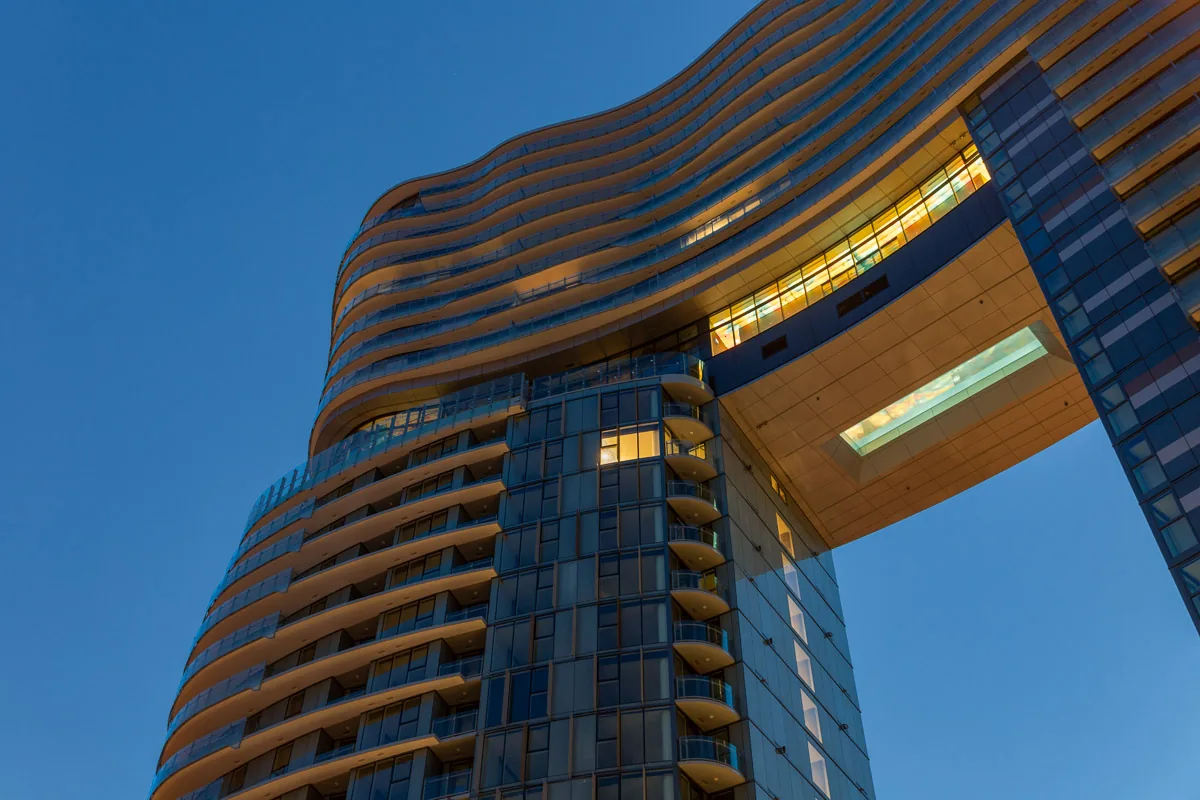
In Calgary, The Concord stands in Eau Claire, on the Bow River at the north edge of downtown. SkyriseCalgary reported in July 2019 that its first phase was complete: a 14-storey building with 218 homes by Concord Pacific with Arthur Erickson and Nick Milkovich Architects. The same report says it stands along banks of the Bow River that had been refurbished shortly before.[33]
In Seattle, Seattle Business magazine reported in July 2019 that Concord Pacific bought a half-block parcel at 2300 to 2350 6th Avenue, in the Denny Triangle next to Amazon's headquarters, for $60 million from HB Management, which stayed on as a joint venture partner. The plan was two 45-storey condo towers called Seattle House. The Skyscraper Center lists the towers at 141.7 metres, topped out, with completion expected in 2026.[34],[35]
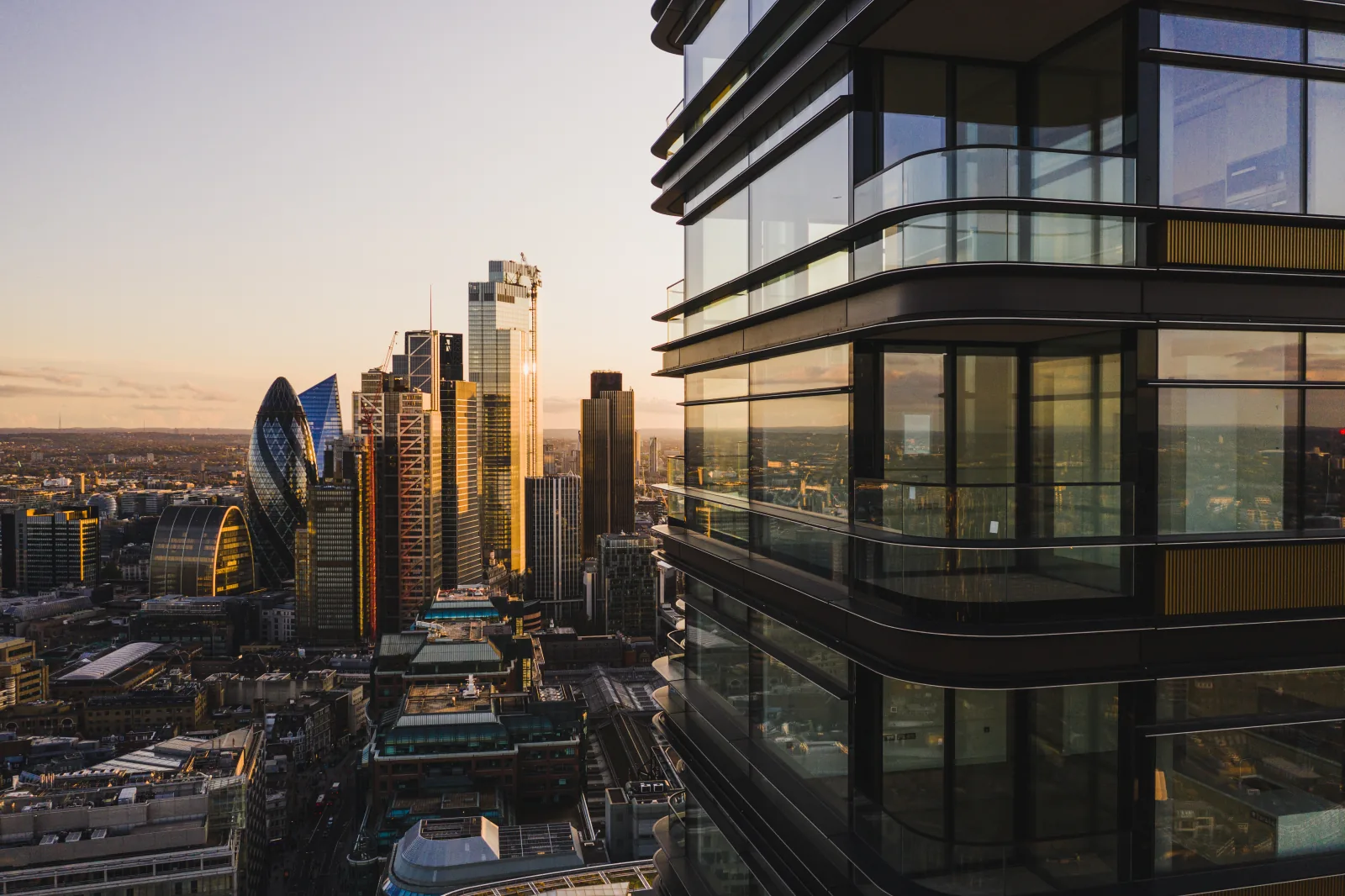
In London, Dezeen reported in November 2019 that Foster + Partners had completed Principal Tower, a 50-storey tower of 299 apartments on the edge of Shoreditch, commissioned by Concord London and Brookfield Properties. Its tallest part rises 162 metres. The company says Concord London was founded by Terry Hui and Christopher Murray, its managing director, and that Principal Tower was its first large project in the city. The company also lists Marylebone Square and W1 Place in London.[36],[19],[9]
Hotels, energy and other businesses
The company says the Concord Group has grown over the past 25 years into software and information technology, telecommunications, and wind, solar and hydroelectric power. Its timeline lists Prompton Real Estate Services for sales and property management in 1989, Novus Entertainment for internet and television in its buildings in 1996, Concord Green Energy in 2011, the Red Lily wind farm in Saskatchewan with 16 turbines, and the purchase of Wind Mobile in 2014.[7]
Concord also bought hotels and large sites in Vancouver. The company's timeline lists the Westin Bayshore and the Sundial Boutique Hotel in Whistler as bought in 2015, while The Tyee reports that Concord paid $290 million for the Westin Bayshore in 2017. The Tyee also reports that Hui bought the Molson brewery site on Burrard Street for $185 million in 2016 and the former St. Paul's Hospital site on Burrard Street, 2.7 hectares, for $850 million in 2021.[7],[2]
The Plaza of Nations case, 2015 to 2022
The Plaza of Nations site lies just east of the Coopers' Park Neighbourhood, and the City's 2004 report asked for a 9-metre setback between Building C and its property line. On May 14, 2015, Concord Pacific Acquisitions Inc. and Oei Hong Leong signed a two-page Heads of Agreement for Concord, or a related company, to buy half of Hong Kong Expo Holdings Ltd., which indirectly owned the lands, and to develop them together. Talks on the full agreements failed, and Concord started its lawsuit on October 30, 2015.[12],[8]
On July 19, 2019, Justice Voith of the Supreme Court of British Columbia dismissed Concord's claim in its entirety, finding that the Heads of Agreement was not binding because it lacked essential terms. On January 29, 2021, he ordered Concord to pay 80 percent of the defendants' special costs, a higher level of costs that the court described as meant to repay a successful party fully or in large part, and wrote that the award addressed "the egregious nature" of Concord's conduct in the case.[8],[38],[39]
On January 18, 2022, the Court of Appeal for British Columbia dismissed Concord's appeal, two judges to one; Justice Stromberg-Stein would have allowed it. On August 18, 2022, the Supreme Court of Canada dismissed, with costs, Concord Pacific Acquisitions Inc.'s application for leave to appeal. OrgBook BC lists that company as registered on July 29, 2014.[39],[14],[13]
A second case followed. Business in Vancouver reported that on March 3, 2020, Oei and his companies filed a claim in the Supreme Court of British Columbia against Terry Hui, Concord Pacific Acquisitions Inc. and others, alleging a conspiracy to tie up the lands in litigation and claiming more than $245 million in damages. The paper noted that the claims had not been tested or proven in court, and this page found no ruling on them.[37]
The non-market housing sites, 1994 to 2024
The 1990 plan for False Creek North set aside sites for non-market housing, homes rented below market rates. The Tyee reports that six such sites stayed empty for decades after federal support for social housing ended in 1994, and that Concord, the Li family and the City disagreed over their future. By The Tyee's account, a confidential settlement in 2013 left Hui as owner of the six sites.[2]
On April 30, 2024, the City announced that Concord had completed a land transfer of three sites, at 990 Beatty Street, 1050 Expo Boulevard and 450 Pacific Street, for more than 670 affordable rental homes. Concord also agreed to pay the City $110 million for the new street network in northeast False Creek and to waive the City's $11 million option price on the three sites, a total of $121 million. The Beatty Street building is planned at 28 storeys with 283 homes, a fire hall and a childcare centre.[6]
The Tyee reports that under the same deal the other three sites became sites for Concord market condos, and that affordable housing across the Expo lands came to half of the 20 percent of all housing promised in the 1990 plan. The City's page on northeast False Creek says Council approved the plan changes for the three non-market sites after a public hearing on July 13.[2],[43]
The last Expo lands parcel and Concord Landing, 2025
On January 7, 2025, Terry Hui said Concord would proceed with rezoning the last undeveloped part of the Expo lands in northeast False Creek, according to The Tyee. Global News reported the next day that Concord's plan, called Concord Landing, shows 12 towers of up to 65 storeys with 5,000 homes on two parking lots between the water and the Georgia and Dunsmuir viaducts. Peter Webb, Concord's senior vice-president of development, told Global News that taller towers became possible after Council changed its protected view rules in 2024.[2],[42],[17]
The City's Northeast False Creek Plan, approved in 2018, calls for replacing the viaducts with streets at ground level, 32 acres of new and renewed parks and open space, and 1,800 social housing homes. Global News reported that Concord spoke of a park of 14 acres, while the 2018 plan showed a new park of 11 acres.[43],[17]
The Tyee also reports that on February 27, 2025, the Province, the City and Concord agreed to a joint negotiating process, and that Concord must still make the final land payment to the Province, part of which would fund the clean-up of contaminated soil. These are news reports, and the plan has no approval on the record we read.[2]
What the project list on this page leaves out
The project list below this story has one row for each named project or community we could find in a source, up to 80 rows. The company says it has completed more than 169 buildings, so many towers sit inside a single row: CityPlace and Concord Park Place in Toronto, and Concord Brentwood and Concord Metrotown in Burnaby, each count as one community row with a few named buildings beside it. Rows that rest only on the company's project list carry the label "As the company lists it".[7],[9]
Some projects the company lists are left out because no source we opened gave their status or year: Park George and Park Boulevard in Surrey, Piano in Surrey, Greenhouse and Circle at Concord Brentwood, Central, The LakeShore, The LakeFront, King's Landing, Saisons, Seasons and Concord Sky in Toronto, Marylebone Square and W1 Place in London, and W1 in Vancouver. The company's About page also lists awards; we left them out because we could not open the awarding bodies' own winners lists to confirm them.[9],[7]